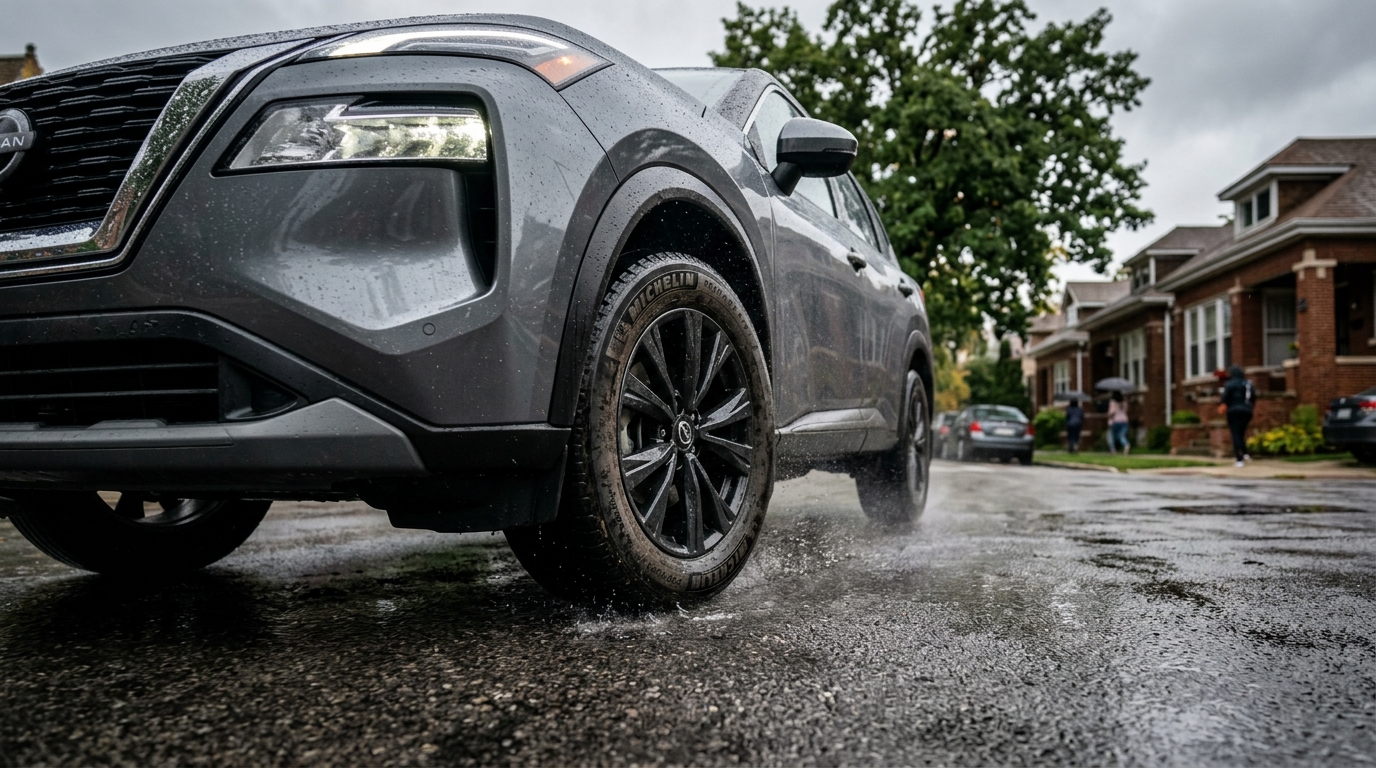
Tires do more than carry the vehicle. They shape braking distance, steering response, road noise, fuel economy, and the margin you have when pavement turns wet or the temperature drops fast. For daily driving in Chicago, that margin matters on crowded streets, stop-and-go traffic, and highway stretches where an underinflated tire can wear unevenly long before the tread is gone.
Most major tire and safety organizations recommend checking pressure at least once a month, then again before a long highway trip or after a sharp temperature swing. In cold weather, pressure can drop by about 1 to 2 psi for every 10°F change in outside temperature, which is enough to push a properly inflated tire into the underinflated range overnight. That is why cold checks are so important in a place like Chicago, where a mild afternoon can turn into a much colder morning.
Rotation matters just as much. A typical interval is every 5,000 to 7,500 miles, which helps distribute wear and makes it easier to catch alignment or suspension issues before they get expensive. Uneven wear on the inner shoulder, outer shoulder, or center of the tread usually points to a problem that should be inspected rather than ignored.
If you want help checking your tires or reading the wear pattern, our service location on Kedzie is easy to find, and you can also give us a quick call at (872) 278-7632 to talk through the right next step.
Table of Contents
- Decoding the Numbers and Letters on Your Tire Sidewall
- How to Use Your Vehicle Tire Placard for Proper Inflation
- Understanding All-Season Tires and Seasonal Performance Needs
- The Lifespan of a Passenger Tire and Key Wear Indicators
- What Factors Determine the Cost and Value of Replacement Tires
- Roadside Safety and When to Call for Professional Assistance
Decoding the Numbers and Letters on Your Tire Sidewall
A tire sidewall gives you the details you need to match the correct replacement, but the code can look more complicated than it is. A size such as 225/65R17 102H breaks down into several parts: 225 is the width in millimeters, 65 is the aspect ratio, R means radial construction, 17 is the wheel diameter in inches, 102 is the load index, and H is the speed rating. Each piece matters because a tire that fits the wheel still may not meet the vehicle’s load or performance requirement.
The load index tells you how much weight one tire can support when it is properly inflated. The speed rating shows the maximum sustained speed the tire is engineered to handle under the right load and inflation conditions. Those numbers should meet or exceed the vehicle’s original specification, not just come close. If you see a different setup on the same axle, or if a previous owner installed a non-standard size, the sidewall alone is not enough to confirm fitment.
Two other markings are worth knowing. M+S means mud and snow, but it is a broad designation. The Three-Peak Mountain Snowflake symbol is more demanding and signals the tire meets a recognized snow traction standard. That difference matters when you are deciding between a general all-season tire and one that can handle more serious winter use.
If you want a broader ownership guide while you compare tire types, our homepage and model-year guide can help you keep the rest of the vehicle in the same maintenance conversation, and our buying versus leasing guide is useful when you want to understand how long you expect to keep the vehicle and its tires.
How to Use Your Vehicle Tire Placard for Proper Inflation
The tire placard is the first place to look before you touch a gauge. It usually sits on the driver’s door jamb and lists the recommended tire size, cold inflation pressure, and load limits for the vehicle. Some vehicles also place the placard inside the fuel filler door, but the purpose is the same: it gives you the manufacturer’s baseline, not a guess from the sidewall.
Cold inflation pressure means the tires have not been driven on recently, usually first thing in the morning or after the vehicle has been parked for at least three hours. That matters because driving heats the air inside the tire and can make the pressure reading look higher than it really is. A check against the placard only makes sense when the tire is cold, since that is the condition used to set the specification.
Using the placard correctly helps prevent both underinflation and overinflation. Underinflated tires can run hotter and wear on the outer shoulders. Overinflated tires can reduce the contact patch and create center wear. Either condition can affect braking and handling, especially when the road is wet or the pavement is uneven.
If you need help locating the placard or confirming what it means on your vehicle, our about page gives you a better sense of our team, and our community work reflects the same practical approach we bring to service conversations. When you are ready to plan ahead for maintenance expenses, take a look at current service offers and ask our team how they apply to tire care.
Understanding All-Season Tires and Seasonal Performance Needs
All-season tires are built to deliver balanced performance in dry, wet, and mild winter conditions. They are a practical choice for drivers who want one set that can handle everyday commuting, light rain, and occasional cold snaps without swapping tires twice a year. In a place with moderate seasonal changes, they offer a good middle ground for comfort, tread life, and everyday traction.
They are not the right answer for every climate. When temperatures stay below freezing for extended periods, or when snow and ice are frequent, all-season rubber loses grip because the compound stiffens in the cold. In those conditions, dedicated winter tires or all-weather tires with the 3PMSF symbol make more sense. That is especially important for drivers in Irving Park who spend time on short city trips and need dependable cold-weather traction without overcomplicating routine maintenance.
Tread design also changes how the tire feels on the road. Touring all-season tires usually emphasize a quieter ride and longer tread life, while performance-oriented designs trade some comfort for sharper steering response. The best choice depends on how you drive most often, not just how the tire looks in a catalog.
For drivers who like to compare real feedback before choosing service work, our customer reviews can offer helpful context. If you want to talk through a seasonal tire change or a tread inspection, our contact page is the fastest way to reach the team that handles it every day.
The Lifespan of a Passenger Tire and Key Wear Indicators
A standard passenger tire often lasts somewhere in the 50,000 to 70,000 mile range, but that number is only a starting point. Tire life depends on inflation habits, rotation timing, alignment, road conditions, and driving style. A tire that sees frequent stop-and-go use, hard cornering, or chronic low pressure may wear out far sooner than its treadwear rating suggests.
Tread depth is the clearest wear marker. The common safety minimum is 2/32 inch, and many tires include built-in wear bars that become flush with the tread when that limit is reached. At that point, wet traction drops sharply, and snow performance becomes poor long before the tire is technically unusable. Age matters too, because rubber degrades over time even when the tread still looks acceptable. Most tire organizations recommend replacement by six years and caution against running tires older than ten years.
Wear pattern tells its own story. Inner-edge wear can point to alignment trouble or inflation issues. Cupping can suggest a suspension problem. Center wear often indicates overinflation. If you spot one of these patterns, replacing the tire without finding the cause usually just repeats the problem on the next set.
If you want a manufacturer-backed service approach for tire inspection and replacement, our Berman Advantage information explains how we support ownership care. Drivers who are also comparing tire needs for electric vehicles can use our EV center as a starting point, since tire load, rolling resistance, and wear patterns can look different on EVs.
What Factors Determine the Cost and Value of Replacement Tires
Tire pricing is shaped by more than size alone. Construction quality, tread compound, speed rating, load capacity, and specialized performance features all influence cost. A basic all-season tire for a passenger car usually costs less than a performance tire, a run-flat tire, or a heavy-duty SUV and truck tire built for higher load demands.
Value is not always the lowest price. A tire with better tread life, stronger wet grip, or a more stable ride can cost less over time if it lasts longer and needs fewer replacements. That is why the tire that fits the wheel is not automatically the best buy. The right measure is how well the tire matches the vehicle’s load, the driver’s habits, and the weather the vehicle actually sees.
Chicago drivers who spend a lot of time in mixed traffic and on highways usually benefit from paying attention to treadwear, road noise, and wet braking rather than chasing the cheapest option on the shelf. A tire that wears evenly and stays predictable in cold rain is often the smarter long-term purchase.
For a closer look at how we stay connected with local drivers, our social channels are a convenient place to follow service updates. If you prefer to speak with someone in person about the best replacement fit for your vehicle, our directions page can help you plan the trip.
Roadside Safety and When to Call for Professional Assistance
A roadside tire change is only worth attempting when the car is on a stable, level surface away from traffic and you have the tools, time, and confidence to do it safely. If the shoulder is narrow, the pavement is soft, or traffic is too close for comfort, the safer choice is to wait for professional help. Safety comes first, especially when the vehicle is sitting low or the wheel is partially buried in slush, gravel, or debris.
Before any attempt, make sure the parking brake is set and the hazard lights are on. If the wheel is damaged, the sidewall is cut, or the tire has come apart, the situation is no longer a simple roadside swap. A bulge, heavy vibration, or repeated air loss also calls for a closer inspection rather than a quick change. In those cases, the tire may have internal damage that is not visible from the outside.
For Nissan owners, manufacturer-backed roadside assistance is the preferred emergency option because it aligns with the vehicle’s service history and warranty coverage. If you need guidance after a flat or want to confirm the next repair step, our team can help with the process and direct you toward the right service appointment. A quick call to (872) 278-7632 is often the easiest way to start.
Drivers who want to stay prepared can also review our model guide to see which vehicles offer the kind of ownership support that fits daily use around Chicago. When road conditions make a do-it-yourself tire change a bad idea, professional assistance is the better call.