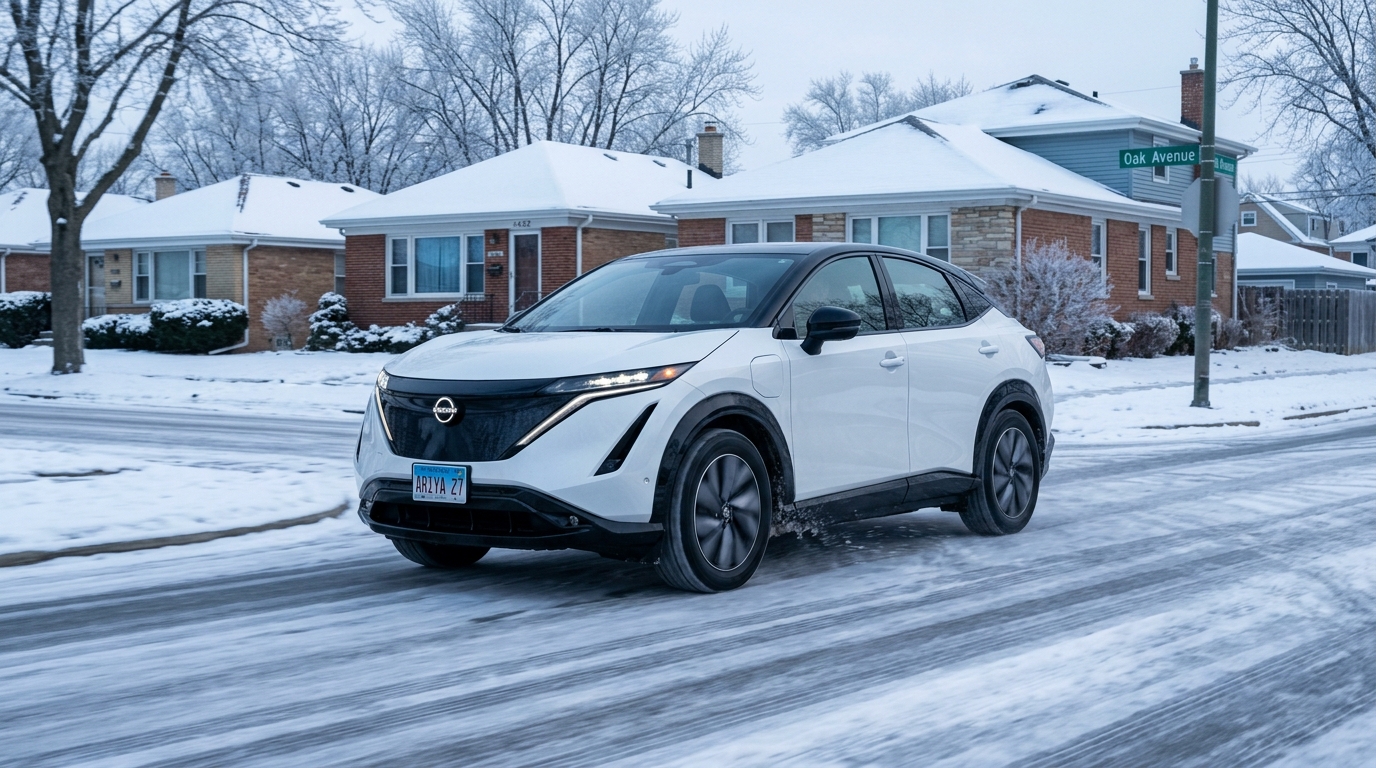
During sub-freezing winter conditions, the Nissan Ariya typically experiences a 20% to 35% reduction in total driving range, lowering real-world distance on extended-range models from an EPA-estimated peak down to roughly 200 to 230 miles. Under severe freeze warnings with continuous cabin heating on repeated short trips, range loss can temporarily reach 40% to 45%. Sub-zero temperatures slow the chemical reactions inside lithium-ion battery cells, increasing internal resistance while climate control systems draw high electrical loads to keep the cabin warm.
Cold winter weather impacts electric vehicles in two primary ways: reduced battery efficiency and elevated energy consumption. When ambient temperatures drop below freezing, the liquid electrolyte inside the battery pack thickens, restricting ionic movement and temporarily reducing usable energy capacity. Simultaneously, the lack of engine waste heat means electric crossovers must draw energy directly from the high-voltage battery to operate resistance heaters or heat-pump systems. Models equipped with an advanced heat pump system mitigate these thermal losses more effectively than standard resistance heating, preserving valuable driving miles when highway cruising.
Traction and motor performance in cold conditions remain exceptionally stable, particularly on trims equipped with e-4ORCE dual-motor all-wheel drive. The dual electric motors monitor wheel slip thousands of times per second, distributing torque instantly between front and rear axles to maintain stability on icy roads. However, heavy snow and cold road surfaces increase rolling resistance, which further increases energy consumption per mile.
For drivers navigating cold winter commutes across Chicago, managing battery thermal state is essential for maintaining predictable daily performance. Parking in an enclosed garage, keeping the vehicle plugged in during severe cold snaps, and utilizing winter drive modes help maintain optimal battery health throughout the coldest months of the year. If you have questions about winter maintenance or battery health diagnostics, reach out to our service team by giving us a quick call or getting turn by turn directions to our Kedzie Avenue showroom.
Table of Contents
- What Is the Usable Battery Capacity and Fast-Charging Speed of the Extended-Range Nissan Ariya?
- How Does Nissan Ariya Winter DC Fast-Charging Compare to Tesla Supercharging?
- How Do You Activate Battery Preconditioning and Minimize Winter Range Loss?
- Is Overnight Home Charging Sufficient for a Daily Commute in Chicago During Harsh Winters?
- Common Service and Technical Questions About Nissan Ariya Winter Operation
- Schedule Certified Nissan Electric Vehicle Winter Service
What Is the Usable Battery Capacity and Fast-Charging Speed of the Extended-Range Nissan Ariya?
The extended-range Nissan Ariya features a usable battery capacity of 87 kWh out of a 91 kWh gross pack capacity, while delivering a peak DC fast-charging rate of 130 kW. Standard-range configurations utilize a smaller 63 kWh battery pack ( 58 kWh usable capacity). Under mild ambient conditions, the 87 kWh battery can charge from 20% to 80% in approximately 40 minutes at a compatible high-speed station.
Nissan engineers designed the Ariya battery architecture with a software-managed buffer that protects the cell chemistry over time. The difference between gross capacity ( 91 kWh) and usable capacity ( 87 kWh) prevents overcharging at upper voltage limits and prevents deep discharge at low states of charge. This protective margin helps slow long-term degradation and supports long-term capacity retention through repeated rapid-charging cycles.
The crossover's peak DC fast-charging rate of 130 kW is sustained smoothly across a flat charging curve rather than spiking briefly and dropping sharply. While some electric vehicles offer higher initial peak charging numbers, the Ariya maintains a consistent intake of energy through the middle portion of the charging cycle. In cold winter weather, however, cold battery cells cannot accept high electrical current safely without pre-warming. Without proper battery preconditioning, initial cold-weather charging speeds may taper lower to safeguard internal cell chemistry until the battery reaches its optimal operating temperature.
Understanding these battery specifications helps owners plan seasonal maintenance and travel routines accurately. To learn more about how electric vehicle battery engineering compares across the vehicle lineup, explore our guide to top Nissan models for local drivers.
How Does Nissan Ariya Winter DC Fast-Charging Compare to Tesla Supercharging?
Tesla Superchargers provide peak charging speeds up to 250 kW, whereas the Nissan Ariya caps its maximum DC fast-charging intake at 130 kW, resulting in slightly longer winter fast-charging stops for the Ariya. While an approved NACS charging adapter allows Ariya drivers to connect directly to Tesla Supercharger hardware, the crossover's onboard battery management system strictly limits power flow to its rated 130 kW ceiling. Consequently, a typical winter 10% to 80% fast-charging session in an Ariya requires roughly 40 to 45 minutes, compared to approximately 25 to 30 minutes for a Tesla Model Y under similar freezing conditions.
Peak charging capability is only one part of the winter charging equation. Tesla vehicles automatically initiate battery thermal preconditioning whenever a Supercharger station is designated in their navigation route, allowing the battery to hit peak charging acceptance immediately upon plug-in. The Nissan Ariya also offers battery preconditioning—either manually via display settings or automatically when a fast charger is set as a navigation waypoint—which significantly bridges the cold-weather charging gap. When fully preconditioned, the Ariya achieves its steady 130 kW rate much faster, avoiding prolonged thermal throttling at the plug.
Furthermore, the Ariya features a liquid-cooled and heated thermal management system designed to keep battery temperatures balanced throughout rapid charging. This thermal control prevents localized hot spots or excessive cold resistance across individual module cells. When weighing daily commuting costs and ownership considerations between different electric powertrain setups, review our comprehensive buying versus leasing comparison guide for additional insights.
How Do You Activate Battery Preconditioning and Minimize Winter Range Loss?
Battery preconditioning in the Nissan Ariya is activated manually through the EV settings menu on the 12.3-inch display or automatically by selecting a public DC fast-charging station as a destination in the factory navigation system. Enabling preconditioning routes electrical power to internal heating elements within the battery casing, warming the lithium-ion cells to their optimal temperature range before fast charging or cold-weather driving begins.
When drivers stop by our service center for winter vehicle checks, one of the most practical tips our technicians share is setting the departure timer in the NissanConnect mobile application while the crossover remains plugged into a Level 2 home charger. Preconditioning the cabin and warming the battery pack using wall power preserves full battery reserves for driving, recovering up to 10% to 15% of energy that would otherwise be expended heating cold components after unplugging.
To maximize cold-weather driving efficiency in the Nissan Ariya, adopt these practical winter driving habits:
- Precondition While Plugged In: Schedule cabin climate and battery prewarming via the infotainment display or smartphone app before leaving your home or charger.
- Utilize Heated Seats and Steering Wheel: Rely on targeted surface heating rather than setting the main cabin climate control to high temperatures, as heated seats consume significantly less battery power.
- Drive in Eco Mode: Engage Eco Mode to smooth out accelerator pedal response and optimize climate control output for reduced battery draw.
- Maintain Correct Tire Pressure: Cold air reduces tire pressure by roughly 1 PSI for every 10-degree drop in ambient temperature; keep tires inflated to recommended specification to minimize rolling resistance.
- Use Regenerative Braking Wisely: Select moderate regenerative braking modes on slick or icy surfaces to maintain predictable vehicle handling and capture kinetic energy during smooth stops.
Is Overnight Home Charging Sufficient for a Daily Commute in Chicago During Harsh Winters?
A dedicated Level 2 home charging setup (240-volt, 40-amp or 48-amp circuit) fully replenishes a depleted extended-range Nissan Ariya battery overnight in roughly 10 to 14 hours, providing more than enough daily range for winter commuting. Even when severe cold weather reduces real-world battery range down to 200 miles, a typical 30-to-50-mile daily suburban trip consumes only a fraction of the total battery reserve, which is easily restored while you sleep.
By contrast, Level 1 charging using a standard 120-volt household wall outlet supplies only 3 to 5 miles of range per hour of charging. During sub-zero cold snaps, a portion of that Level 1 electrical current is redirected toward basic battery heater maintenance, leaving minimal power for actual cell charging. For drivers handling daily highway commutes from Park Ridge into downtown commercial districts, relying solely on a 120-volt outlet during winter can leave the vehicle short of a full charge by morning.
Installing a hardwired or high-amperage Level 2 EVSE (Electric Vehicle Supply Equipment) in an enclosed garage provides the ultimate winter charging setup. Garaged home charging shields the vehicle from harsh wind chills, speeds up preconditioning cycles, and ensures you start every winter morning with a fully warmed cabin and a 100% charged battery pack.
Common Service and Technical Questions About Nissan Ariya Winter Operation
Q: How much driving range does the Nissan Ariya lose in freezing winter weather?
A: The Nissan Ariya typically loses between 20% and 35% of its EPA-rated driving range during cold winter weather. On models with the extended-range 87 kWh battery, real-world highway driving distance generally ranges between 200 and 230 miles in freezing temperatures. Extreme conditions, such as sub-zero weather combined with high heater usage on short, frequent stops, can cause temporary range reductions of up to 40% to 45%.
Q: How do I manually turn on battery preconditioning before fast charging?
A: You can manually activate battery preconditioning by accessing the EV settings menu on the central 12.3-inch display screen and selecting the battery heater option. Alternatively, setting a DC fast-charging location as your destination in the factory built-in navigation system will automatically trigger preconditioning as you approach the station. Activating this feature 20 to 30 minutes prior to plugging in ensures faster DC charging speeds in cold weather.
Q: What is the maximum DC fast-charging speed of the Nissan Ariya during winter?
A: The Nissan Ariya has a maximum DC fast-charging rate of 130 kW. In winter conditions, reaching this peak speed depends heavily on battery temperature. If the battery is cold when plugged in, charging power may initially cap at lower rates to protect cell health. Once preconditioned or warmed during driving, the Ariya can charge from 20% to 80% capacity in approximately 40 minutes at a compatible high-speed DC station.
Q: What warranty protection covers the Nissan Ariya electric vehicle battery?
A: Nissan covers the high-voltage lithium-ion battery pack with an 8-year/100,000-mile battery warranty (whichever occurs first). This factory warranty protects against defects in materials or workmanship and guarantees coverage against excessive capacity loss below 9 out of 12 bars on the vehicle battery capacity gauge. Routine winter inspection of battery thermal management systems by certified technicians helps maintain optimal battery health throughout the warranty period.
Q: Should I keep my Nissan Ariya plugged into a charger during severe cold snaps?
A: Yes, keeping your Ariya plugged into a Level 2 charger during extreme freezing weather is highly recommended. When connected to grid power, the vehicle can draw electricity directly from the wall to run internal thermal management heaters, maintaining the battery pack at a safe temperature without draining stored driving range. It also allows you to pre-warm the cabin before your morning commute while preserving a full charge.
Schedule Certified Nissan Electric Vehicle Winter Service
Proper seasonal care and routine system inspections ensure your Nissan Ariya delivers dependable performance, rapid charging, and maximum safety through every Midwest winter. Our factory-trained technicians at Berman Nissan of Chicago specialize in electric vehicle systems, high-voltage battery health diagnostics, thermal management inspections, and tire maintenance. From verifying software updates for climate systems to conducting multi-point safety checks, our service department provides expert care tailored specifically to your electric crossover.
Whether you need a seasonal battery health check, brake fluid service, or advice on home Level 2 charging setups, our experienced team is here to assist you. Contact our service department today by giving our staff (872) 278-7632 a call or visiting our service center on Kedzie Avenue to schedule your next maintenance appointment.