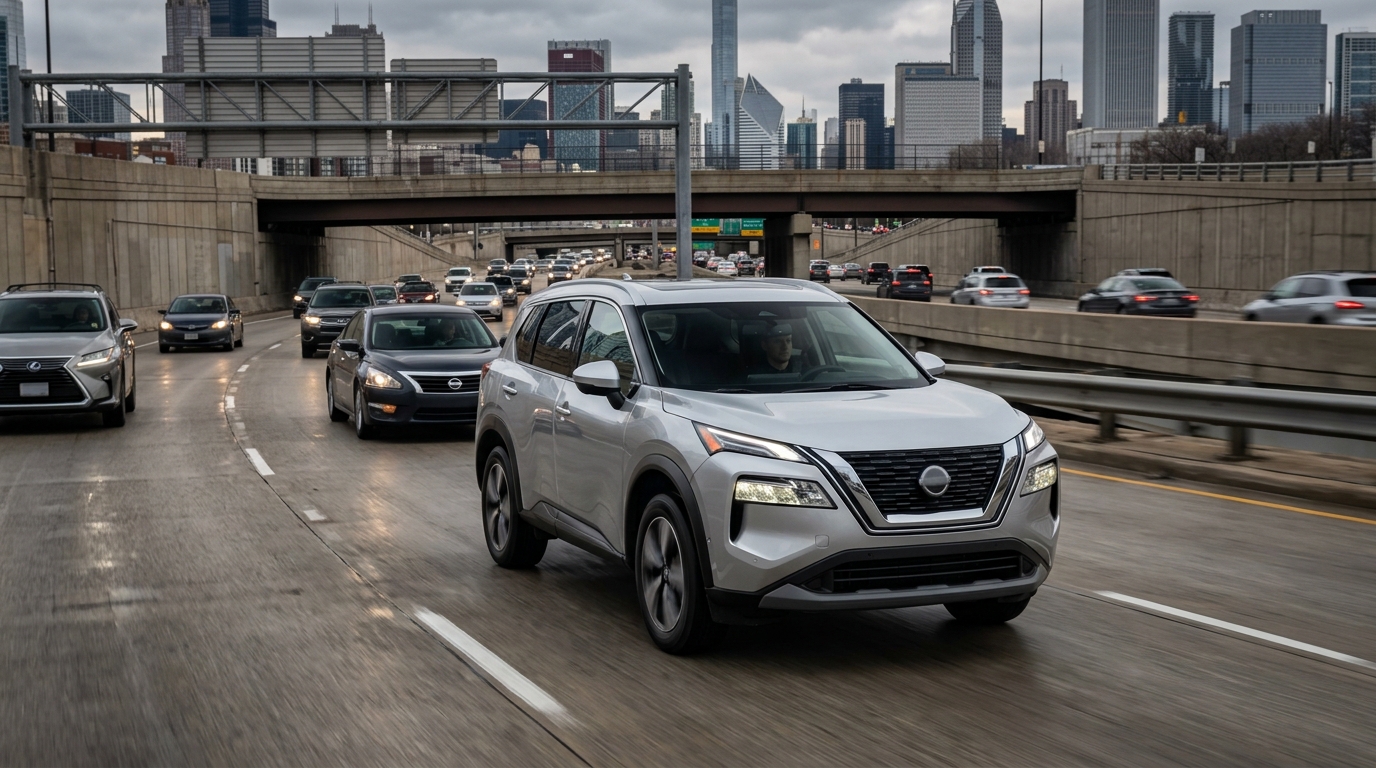
Nissan ProPILOT Assist is exceptionally effective in heavy expressway traffic, combining Intelligent Cruise Control and Steering Assist to manage acceleration, braking, and lane centering during stop-and-go conditions. The system reduces commuter fatigue by maintaining safe following distances and bringing the vehicle to a complete stop when congestion stalls, making it a reliable driver-assist technology for demanding highway environments.
Navigating dense traffic requires continuous alertness, quick braking reactions, and subtle steering adjustments. Next-generation ProPILOT Assist technology uses a forward-facing radar and high-resolution camera array to monitor surrounding vehicles and lane boundaries simultaneously. When traffic slows unexpectedly, the system modulates brake pressure to decelerate smoothly rather than applying harsh, sudden braking. This measured approach keeps movement predictable for cars behind you while preserving brake component life over thousands of commuting miles.
Beyond managing speed, the system provides subtle steering inputs to keep the vehicle positioned squarely in the center of its lane. Drivers retain ultimate control and must keep their hands on the wheel, but the electronic guidance eliminates the micro-steering corrections that cause shoulder and arm tension during long traffic delays. If you want to verify that your vehicle's driver-assist cameras and distance sensors are performing to factory standards before your next major road trip, our certified technicians at our Kedzie Avenue location can perform a complete system diagnostic, or you can give our service team a quick call to speak with a technician directly.
Table of Contents
- What Does ProPILOT Assist Do on the Highway and Where Does It Work Best?
- How Does Nissan ProPILOT Assist Handle Stop-and-Go Traffic on the Kennedy Expressway?
- Can ProPILOT Assist 2.1 Work Anywhere with Lane Markings and Construction Zones?
- How Does Nissan ProPILOT Assist Compare to Tesla Autopilot in Heavy Traffic?
- How Do Radar Calibration and Camera Maintenance Keep ProPILOT Assist Performing Reliably?
- Frequently Asked Questions About ProPILOT Assist Service and Operation
What Does ProPILOT Assist Do on the Highway and Where Does It Work Best?
ProPILOT Assist integrates single-lane steering support and adaptive speed control to maintain a pre-set distance behind target vehicles while keeping the car centered within clear road markings. It operates best on open, well-mapped highways and controlled-access expressways with distinct lane paint and predictable traffic patterns.
The technology acts as an intelligent co-pilot during long highway stretches. Once activated via steering-wheel controls, the system scans for the vehicle directly ahead while reading left and right lane boundaries. On multi-lane highways, ProPILOT Assist with Navi-link uses navigation data to anticipate upcoming road geometry. It automatically adjusts vehicle speed when approaching sharp freeway curves, highway interchanges, or lower posted speed zones, reducing the need for constant cruise control manual resetting.
Vehicles equipped with ProPILOT Assist, such as the Nissan Rogue SL, Rogue Platinum, and Armada SL, perform best on roads designed for high-speed travel without cross-traffic or traffic signals. Controlled-access ramps, concrete barriers, and clearly painted reflective lines give the optical camera and radar hardware optimal target data. To see which models feature this highway technology, explore our detailed model breakdown highlighting driver-assist options across the lineup.
How Does Nissan ProPILOT Assist Handle Stop-and-Go Traffic on the Kennedy Expressway?
In heavy gridlock on the Kennedy Expressway, ProPILOT Assist automatically slows the vehicle to a complete halt, holds the position, and automatically resumes speed if traffic moves within three seconds. If the stop exceeds three seconds, the driver simply taps the accelerator pedal or presses the RES+ steering wheel button to re-engage cruise control.
The Kennedy Expressway is notorious for sudden speed drops and prolonged idle periods. During stop-and-go congestion, the system monitors the clearance buffer ahead down to zero miles per hour. When the lead vehicle stops, ProPILOT Assist applies hydraulic brake pressure through the anti-lock braking module to bring your vehicle to a complete, stable stop without rolling. This automated holding capability prevents driver foot fatigue caused by resting continuously on the brake pedal.
For drivers commuting from Park Ridge toward downtown, the constant deceleration during peak travel hours places elevated stress on the braking system. When ProPILOT Assist manages heavy traffic braking, it applies smooth pressure through the Intelligent Cruise Control system, minimizing uneven brake pad wear.
- Automatically matches speed changes of the vehicle ahead.
- Holds full braking pressure when traffic comes to a complete standstill.
- Resumes forward movement automatically during short stops under three seconds.
- Alerts the driver with visual and audible prompts when manual intervention is required.
Can ProPILOT Assist 2.1 Work Anywhere with Lane Markings and Construction Zones?
ProPILOT Assist 2.1 cannot operate on every road with lane lines because hands-free capabilities rely on high-definition 3D mapping paired with controlled-access highway infrastructure. In active construction zones, faded paint, or complex lane shifts, the system prompts the driver to resume manual steering immediately.
While standard ProPILOT Assist functions on most marked highways, ProPILOT Assist 2.1 uses 3D high-definition mapping data to allow hands-off single-lane driving on compatible, pre-mapped expressways. However, system operation depends heavily on optical clarity and mapped road geometry. When entering a construction corridor where lanes are temporarily redirected using concrete pylons or orange barrels, the system detects the anomaly and alerts the driver to take full manual control.
Environmental factors and highway conditions can temporarily restrict driver-assist availability:
- Faded, worn, or covered lane markings prevent camera centering logic from tracking boundaries.
- Heavy rain, road spray, or packed snow across the radar cover disables distance tracking.
- Direct sun glare into the windshield camera aperture blinds optical recognition sensors.
- Construction zones with overlapping painted lines trigger manual takeover prompts.
When these conditions occur, the vehicle issues clear audible tones and instrument cluster alerts, disengaging steering support while keeping standard braking and engine controls under direct driver management.
How Does Nissan ProPILOT Assist Compare to Tesla Autopilot in Heavy Traffic?
While both systems deliver adaptive cruise control and lane centering, ProPILOT Assist emphasizes predictable, hands-on driver supervision and smoother manual handoffs, whereas Tesla Autopilot relies heavily on vision-only processing across unmapped roads. ProPILOT Assist provides a balanced driver-monitoring interface that minimizes unexpected disengagements in tight expressway corridors.
In dense metropolitan traffic, predictability is vital. Tesla Autopilot utilizes a vision-based camera array that processes all driving logic through optical data alone. In contrast, Nissan utilizes a dual-technology approach combining millimeter-wave radar behind the front grille with an optical camera behind the rearview mirror. The radar measures physical distance and relative speed through fog, dust, and rain, while the camera tracks lane lines. This multi-sensor redundancy helps prevent phantom braking scenarios where optical shadows might falsely trigger sudden speed drops.
Furthermore, ProPILOT Assist is calibrated to prioritize smooth manual steering overrides. If a driver needs to steer around debris or give extra room to an aggressive lane-merger, gently turning the wheel allows manual maneuvering without harshly jarring the steering wheel or disengaging the entire cruise control system. Maintaining proper camera calibration and sensor alignment is essential for keeping these safety systems functioning, whether considering buying versus leasing options for your next vehicle.
| System Feature | Nissan ProPILOT Assist | Tesla Autopilot |
|---|---|---|
| Sensor Hardware | Millimeter-Wave Radar + Optical Camera | Vision-Only Camera Array |
| Steering Hand-Off | Smooth manual override without system shock | Hard disengagement requiring system reset |
| Map Integration | HD 3D Mapping on ProPILOT 2.0 / 2.1 | GPS Navigation Route Guidance |
| Driver Monitoring | Capacitive steering wheel sensors / IR camera | Steering wheel torque detection |
How Do Radar Calibration and Camera Maintenance Keep ProPILOT Assist Performing Reliably?
Precision radar calibration and windshield camera alignment ensure that ProPILOT Assist accurately calculates following distances and detects lane boundaries. Minor front-end impacts, suspension work, or windshield replacements can misalign sensor optics, requiring computerized service diagnostics to restore factory tracking accuracy.
The forward-facing radar module operates with pinpoint angular tolerance. Even a slight alignment shift of one degree can cause the radar beam to target vehicles in adjacent lanes rather than the car directly ahead. Residents in Irving Park who navigate tight street parking know that minor bumper taps can shift radar alignment angles without leaving visible cosmetic damage. When this happens, driver-assist systems may disengage unexpectedly or delay distance calculations.
Certified maintenance for ProPILOT Assist involves specialized digital calibration targets and alignment racks:
- Windshield Replacement Recalibration: Installing a new windshield requires calibrating the optical camera mounted behind the glass to match factory sightline angles.
- Radar Target Aiming: Technicians use reflector targets and diagnostic software to align the front bumper radar sensor.
- Sensor Dome Cleaning: Keeping the front emblem and radar housing free from road grime, bugs, and winter road salt prevents signal attenuation.
- System Software Updates: Factory-trained technicians install module firmware updates to refine tracking logic and sensor response times.
Routine multi-point inspections at authorized service centers verify that driver-assist modules communicate correctly with the anti-lock brakes, engine control unit, and steering rack, ensuring system safety over the life of the vehicle.
Frequently Asked Questions About ProPILOT Assist Service and Operation
How do I know if my ProPILOT Assist radar needs professional calibration?
Q: How do I know if my ProPILOT Assist radar needs professional calibration?
Your vehicle will display a system warning icon on the digital dashboard if sensor alignment falls outside factory tolerances. Indications include frequent unexpected system disengagements, failure to detect clear lane markings on dry pavement, or delayed speed adjustments when traffic slows. If these symptoms occur, our service center can perform an electronic sensor diagnosis.
What should I do if road salt or snow disables my highway steering assist?
Q: What should I do if road salt or snow disables my highway steering assist?
Gently wipe away accumulation from the front grille emblem and upper windshield area behind the rearview mirror using a soft cloth. Heavy road salt crust or slush blocks the radar beam and blinds the optical camera, causing the system to temporarily deactivate for safety until sensor glass is clear.
Does replacing a damaged windshield affect my lane centering system?
Q: Does replacing a damaged windshield affect my lane centering system?
Replacing a windshield requires a precise camera recalibration procedure to align the camera optical field with vehicle steering angles. Installing new glass without calibrating the camera can cause inaccurate lane positioning or complete system fault codes.
Why does ProPILOT Assist prompt me to touch the wheel when my hands are already on it?
Q: Why does ProPILOT Assist prompt me to touch the wheel when my hands are already on it?
The steering wheel uses capacitive sensors or torque detection to confirm driver involvement. If you hold the wheel with a very light grip without applying minor steering resistance on straight highways, the system may assume your hands are off the wheel. Applying a slight, steady touch satisfies the safety sensor.
How often should driver-assist sensors be inspected by a technician?
Q: How often should driver-assist sensors be inspected by a technician?
Driver-assist sensors should be inspected during every routine service visit or whenever your vehicle receives alignment work, suspension repairs, or body maintenance. Regular inspections ensure that physical brackets remain secure and radar domes stay free of corrosion. If you have questions about your system performance, visit our dealership service department or give our service team a quick call to schedule a technician consultation.