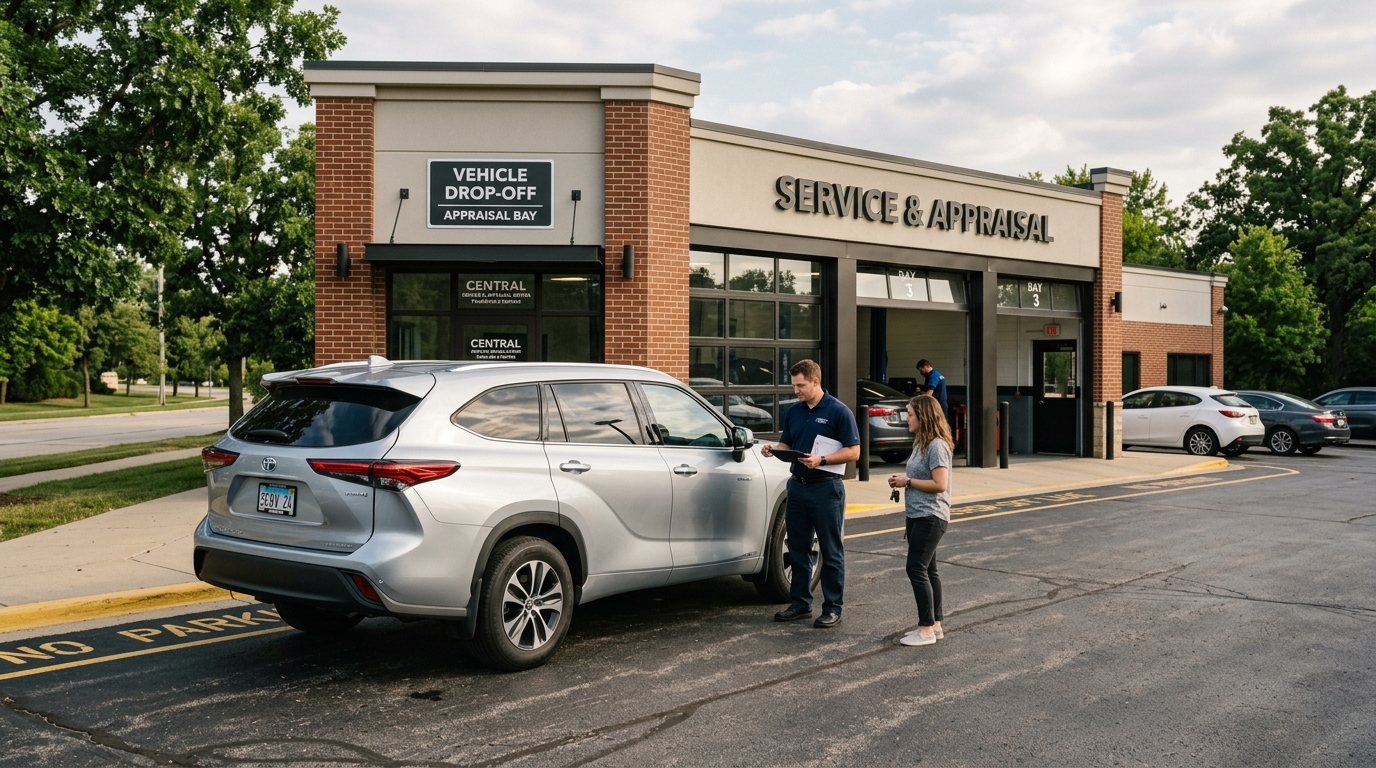
Trading in a vehicle at a dealership involves a straightforward four-step process: bringing your car in for a physical appraisal, establishing its current market value, applying that trade-in allowance directly toward your purchase or loan balance, and completing the ownership transfer paperwork. The agreed-upon trade value functions as direct credit, reducing your overall transaction cost or providing down payment equity for your next vehicle.
When you bring a vehicle to our dealership, our appraisers inspect the exterior, interior, mechanical systems, and underlying diagnostic data. We check regional wholesale market transactions, auction values, and local demand to calculate a competitive trade allowance. If you owe money on your current vehicle, our finance team calculates your net equity by subtracting your remaining loan balance from the appraisal figure. Positive equity reduces the purchase price of your next car, while negative equity can often be rolled into your new financing agreement.
For drivers navigating daily commutes along major highways like I-294 into Chicago, trading in a used vehicle eliminates the stress, safety risks, and delays of arranging private test drives with strangers. You hand over the keys, sign the state title transfer or lien release documents, and apply your vehicle's value instantly. To begin your evaluation, stop by our showroom at 3456 N Kedzie Ave or speak with our sales specialists directly at (872) 278-7632.
Table of Contents
- How Do Dealerships Assess Vehicle Condition, Options, and Carfax History?
- Can You Trade In a Car With an Active Loan, and How Does Lender Payoff Work?
- How Do Sales Tax Savings and Instant Cash Offers Boost Trade-In Financials?
- What Is the Best Way to Remove Personal Data and Factory-Reset Infotainment Systems?
- What Chicago Drivers Ask Most About Vehicle Trade-Ins
- Ready to Trade In? Take the Next Step
How Do Dealerships Assess Vehicle Condition, Options, and Carfax History?
Dealerships evaluate trade-in vehicles using standardized condition categories, vehicle history reports, factory equipment packages, and physical inspection findings to determine expected reconditioning expenses and resale appeal. Appraisers examine every vehicle through specific operational tiers:
- Excellent: The vehicle looks and drives like new, showing zero mechanical issues, no paint defects, clean tire tread, complete maintenance records, and two original keys.
- Very Good: The car has minor cosmetic blemishes, such as light surface scratches, but remains free of mechanical faults or structural damage.
- Good: Normal wear and tear for its age and mileage, requiring routine reconditioning like minor dent repair, detailing, or new tires.
- Fair: Shows significant mechanical or cosmetic defects, worn interior materials, or pending repairs that require substantial reconditioning before resale.
Vehicle history reports play a major role in valuation. A minor accident on Carfax with fully repaired cosmetic damage reduces value slightly, typically by 10% to 15%, whereas major accidents involving airbag deployment or structural frame damage cause much larger value reductions because of wholesale risk. Missing key fobs also reduce trade-in offers by $150 to $400 because modern smart keys require specialized electronic programming to replace.
Factory options significantly increase an appraisal. Equipment like all-wheel drive, panoramic moonroofs, three-row seating, and driver-assist suites including blind spot monitoring retain strong market value. For example, a 2026 Nissan Rogue in S FWD trim with its 1.5L engine, Xtronic transmission, and 29 city / 36 hwy mpg brings solid core value, but step-up trims with all-wheel drive and added tech fetch higher trade allowances. Similarly, family-sized models like the 2026 Nissan Pathfinder featuring a 3.5L V6 engine, automatic 9-speed transmission, and 6,000 lbs towing capacity carry premium demand.
In urban settings like Irving Park, tight street parking frequently results in minor bumper scuffs or rim rash over time. Having receipts for recent maintenance or fixing minor cosmetic flaws helps preserve your vehicle's condition tier when you get directions to our dealership for an in-person assessment, and our team can also walk you through our extensive certified pre-owned inventory while your car is evaluated.
Pricing
Pricing by trim
| Feature | Dark Armor | Dark Armor AWD | Platinum AWD | Rock Creek AWD | S AWD | S FWD | SL AWD | SL FWD | SV AWD | SV FWD |
|---|---|---|---|---|---|---|---|---|---|---|
| Base MSRP | $33,340 | $34,740 | $39,390 | $34,390 | $30,890 | $29,490 | $36,990 | $35,590 | $31,890 | $30,490 |
| Destination charge | $1,545 | $1,545 | $1,545 | $1,545 | $1,545 | $1,545 | $1,495 | $1,495 | $1,545 | $1,545 |
Can You Trade In a Car With an Active Loan, and How Does Lender Payoff Work?
You can trade in a vehicle even if you do not possess the physical title due to an active lender lien. The dealership handles the payoff process directly with your financial institution, obtaining an official 10-day payoff quote and transferring the exact funds owed to release the lien.
To initiate the payoff, our finance team collects your lender's name, your loan account number, and your authorization to contact the institution. The lender provides a precise 10-day payoff figure that accounts for your remaining principal plus daily accrued interest. Once the trade agreement is signed, our business office sends payment directly to your lender. The financial institution then clears the lien and mails the physical title straight to our dealership.
The financial outcome depends on your vehicle's equity position:
- Positive Equity: Your trade appraisal exceeds your loan payoff amount. For instance, if your vehicle is appraised at $18,000 and your payoff is $14,000, you have $4,000 in positive equity to use as a cash-equivalent down payment.
- Negative Equity: Your loan payoff exceeds your trade appraisal value. If your vehicle is valued at $12,000 but your payoff is $15,000, you have $3,000 in negative equity.
When negative equity exists, you can pay the difference out of pocket or roll the remaining balance into your new vehicle's financing structure, subject to credit approval. To understand your options before visiting, explore our streamlined trade-in process or learn about our tailored financing options for various credit situations.
How Do Sales Tax Savings and Instant Cash Offers Boost Trade-In Financials?
Trading in a vehicle offers a distinct financial advantage through state sales tax credit laws, which allow buyers to pay sales tax only on the net difference between the new vehicle's price and the trade-in allowance.
If you purchase a new vehicle for $35,000 and receive a trade-in allowance of $15,000, state sales tax applies only to the remaining $20,000 net balance rather than the full $35,000 purchase price. Assuming a combined local tax rate of 10%, this tax structure saves you $1,500 directly at signing—money you would forfeit if you sold your vehicle privately and made a separate purchase.
Understanding the difference between trade estimates and firm offers helps buyers budget accurately:
- Standard Trade-In Estimate: An informal, preliminary price range based on online market data and user-reported conditions. It serves as a general guide but requires physical verification.
- Instant Cash Offer: A firm, guaranteed written offer to purchase your vehicle immediately at a specific dollar amount. Valid for 7 days or 500 miles, an Instant Cash Offer provides an exact benchmark that protects you against market fluctuations during your shopping timeline.
What Is the Best Way to Remove Personal Data and Factory-Reset Infotainment Systems?
The best way to remove personal data from a vehicle is to navigate to the infotainment system's settings menu, locate the system management options, and execute a full 'Factory Reset' or 'Clear All Personal Data' command. Modern infotainment systems store sensitive details, including garage door codes, home addresses, phonebook contacts, and call logs.
Follow these step-by-step instructions before surrendering your keys:
- Unpair Bluetooth Devices: Access the Bluetooth settings menu, select every connected mobile device, and manually choose 'Delete' or 'Forget Device'.
- Clear Phonebook and Call History: Confirm that saved contacts, recent calls, and text message threads are completely erased from internal head-unit memory.
- Delete Saved Locations: Open the onboard navigation system and delete saved favorites, previous destinations, and your programmed home address.
- Clear HomeLink Garage Door Codes: Press and hold the two outer buttons on your auto-dimming rearview mirror or overhead console for 20 seconds until the indicator light flashes, clearing saved radio frequencies.
- Execute System Master Reset: Locate the system settings menu, select 'Factory Reset', and confirm the action to restore the head unit to its original factory state.
Performing this reset automatically clears wireless integration profiles, such as Apple CarPlay paired connections, keeping your data private. Sedans like the 2026 Nissan Altima—featuring a 2.5L engine, 26 city / 36 hwy mpg, and about 15 cu ft of trunk space—and crossovers like the Rogue rely on these digital head units. You can explore our lineup of versatile vehicles to see how updated connectivity features operate in new models.
What Chicago Drivers Ask Most About Vehicle Trade-Ins
Q: Do missing key fobs really lower my trade-in offer?
Yes, missing smart keys or remote key fobs reduce a trade-in valuation by $150 to $400. Modern electronic keys contain proximity chips and remote start transponders that require specialized key-cutting and software programming before a dealership can place the vehicle for resale.
Q: Can I trade in a leased vehicle from a different brand?
Most leased vehicles can be traded in prior to lease maturity, depending on the leasing bank's third-party buyout rules. Our finance managers contact the leasing institution to calculate the exact payoff amount and execute the purchase agreement directly.
Q: How long does a physical trade-in appraisal take at the dealership?
A physical trade appraisal typically takes 20 to 30 minutes. An appraiser inspects the body integrity, checks fluid levels and tire depth, scans diagnostic trouble codes, and cross-references live regional market data to establish a firm offer.
Q: What physical documents must I bring to complete a trade-in with an active lien?
You should bring a valid state-issued driver's license, your current vehicle registration card, proof of auto insurance, your loan account number, and all existing key fobs and owner manuals.
Q: Does keeping detailed service records increase my vehicle's trade appraisal?
Documented service records increase trade-in value by proving consistent maintenance. Presenting receipts for oil changes, brake services, and scheduled inspections reassures appraisers regarding mechanical condition, elevating the vehicle into higher condition tiers.
Ready to Trade In? Take the Next Step
In Chicago, dealerships typically offer instant online appraisals to help you understand your vehicle's trade-in value before visiting in person. Our appraisal team evaluates every make and model with complete pricing clarity, helping you maximize your vehicle's value while taking advantage of state sales tax credits.
Explore popular options like the 2026 Nissan Rogue lineup, available across trims tailored to your driving preferences:
- S FWD: Base MSRP $29,490 (plus $1,545 destination), 3,530 lbs curb weight, 1,034 lbs payload, about 32 cu ft cargo.
- S AWD: Base MSRP $30,890, 3,607 lbs curb weight, 1,166 lbs payload, about 32 cu ft cargo.
- SV FWD: Base MSRP $30,490, 3,530 lbs curb weight, 1,111 lbs payload, about 32 cu ft cargo.
- SV AWD: Base MSRP $31,890, 3,657 lbs curb weight, 1,116 lbs payload, about 32 cu ft cargo.
- SL FWD: Base MSRP $35,590 (plus $1,495 destination), 3,565 lbs curb weight, 1,076 lbs payload, about 36.5 cu ft cargo.
- SL AWD: Base MSRP $36,990, 3,694 lbs curb weight, 1,039 lbs payload, about 36.5 cu ft cargo.
- Platinum AWD: Base MSRP $39,390 (plus $1,545 destination), 3,737 lbs curb weight, 996 lbs payload, about 36.5 cu ft cargo.
- Rock Creek AWD: Base MSRP $34,390, 3,713 lbs curb weight, 972 lbs payload, about 32 cu ft cargo.
- Dark Armor: Base MSRP $33,340, 3,530 lbs curb weight, 1,111 lbs payload, about 32 cu ft cargo.
- Dark Armor AWD: Base MSRP $34,740, 3,657 lbs curb weight, 1,116 lbs payload, about 32 cu ft cargo.
All configurations accommodate 5 passengers comfortably while delivering versatile utility for daily travel. Plan your visit to visit our showroom at 3456 N Kedzie Ave, or give our sales team (872) 278-7632 to schedule your professional trade appraisal today.
Dimensions & Capacity
Capacity and dimensions by trim
| Feature | Dark Armor | Dark Armor AWD | Platinum AWD | Rock Creek AWD | S AWD | S FWD | SL AWD | SL FWD | SV AWD | SV FWD |
|---|---|---|---|---|---|---|---|---|---|---|
| Seating | 5 | 5 | 5 | 5 | 5 | 5 | 5 | 5 | 5 | 5 |
| Cargo | 31.6 cu ft | 31.6 cu ft | 36.5 cu ft | 31.6 cu ft | 31.6 cu ft | 31.6 cu ft | 36.5 cu ft | 36.5 cu ft | 31.6 cu ft | 31.6 cu ft |
| Curb weight | 3,530 lbs | 3,657 lbs | 3,737 lbs | 3,713 lbs | 3,607 lbs | 3,607 lbs | 3,694 lbs | 3,565 lbs | 3,657 lbs | 3,530 lbs |
| Payload | 1,111 lbs | 1,116 lbs | 996 lbs | 972 lbs | 1,166 lbs | 1,034 lbs | 1,039 lbs | 1,076 lbs | 1,116 lbs | 1,111 lbs |